Compliance Deployments
A compliance deployment runs a compliance framework on a set of endpoints and collects the results: which rules passed, failed, or couldn't be evaluated on each machine.
Compliance needs the ZiroXpose edition or higher (EndpointOps includes it) and the View Compliance permission.
How to get here
You need the View Compliance permission. Creating, editing, and deleting deployments need Create Compliance, Update Compliance, and Delete Compliance.
- In the left sidebar, click Compliance.
- Click the Compliance Deployment tab on the left.
Navigate to: Compliance → Compliance Deployment
URL path: /compliance/deployments
The Compliance Deployment screen
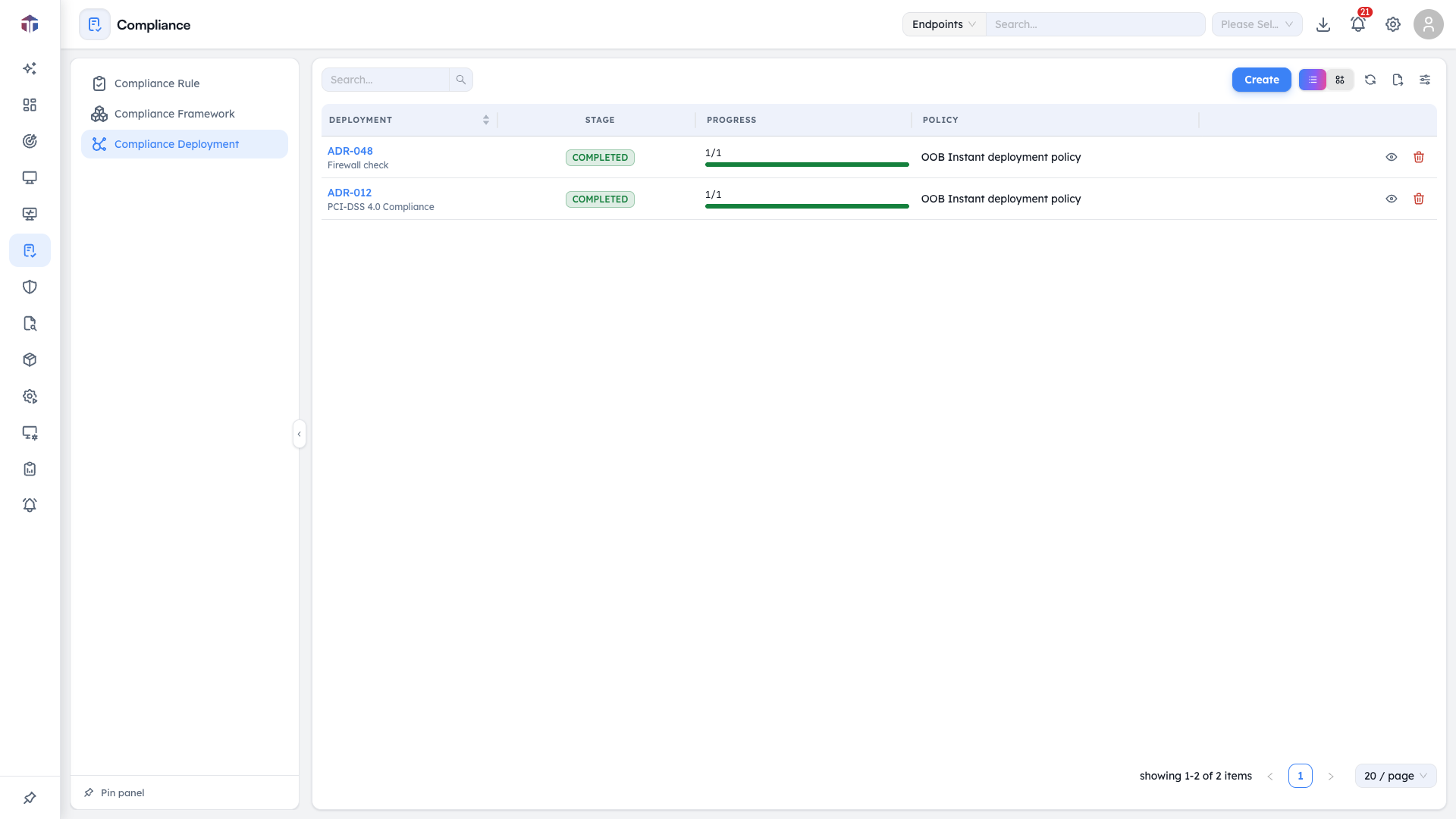
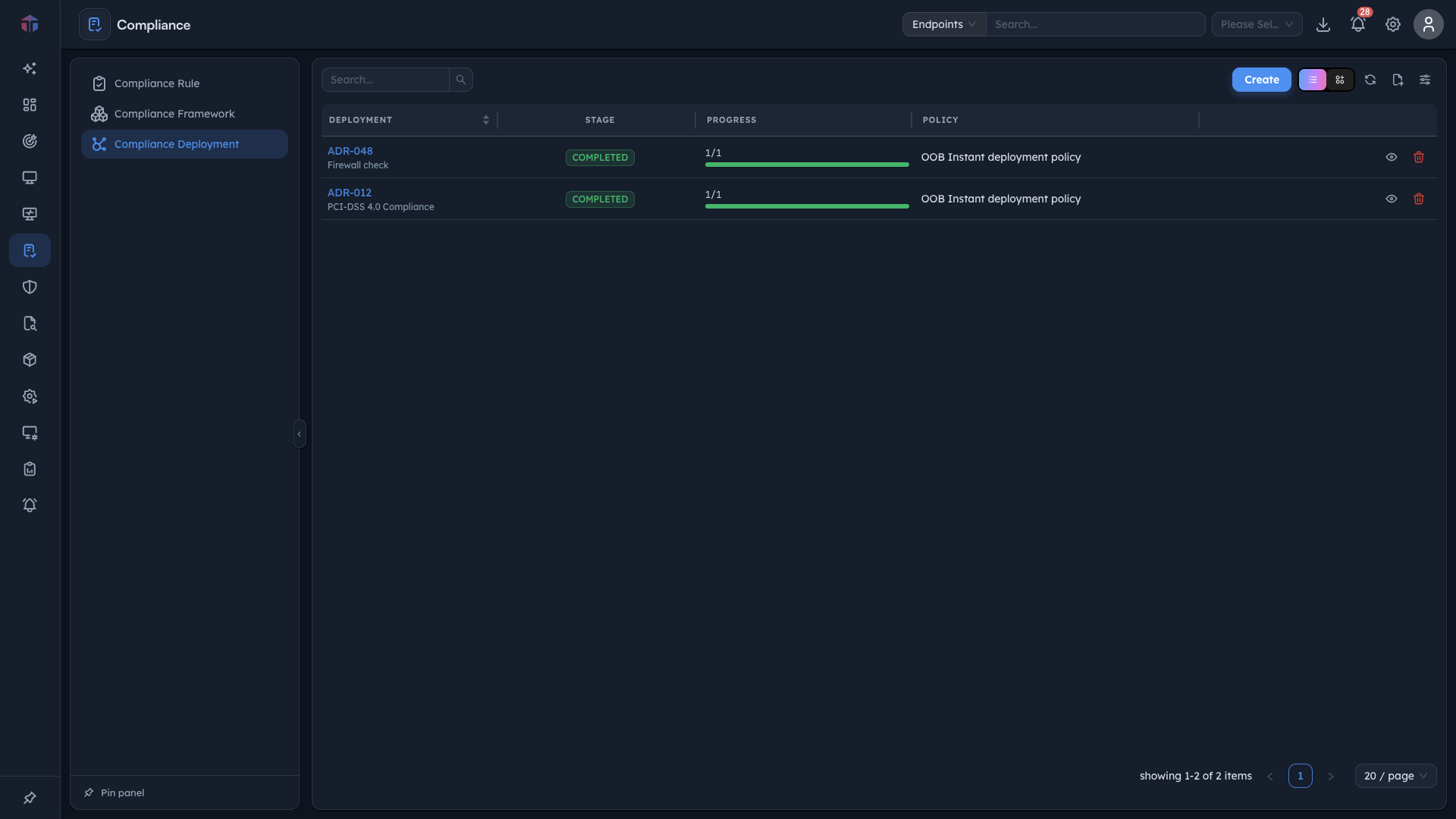
| Column | What it shows |
|---|---|
| Deployment | The deployment's ID, with its name underneath. Click the ID to open the deployment read-only. |
| Stage | Draft, Initiated, In Progress, Completed, Failed, or Cancelled. |
| Progress | Finished tasks out of the total (for example 3/5) over a bar of completed and failed tasks. Hover the bar for the counts. A deployment with no tasks yet shows No tasks. |
| Policy | The deployment policy it runs under. |
| Created By | Hidden by default. Who created it. |
| Description | Hidden by default. |
| Created On | Hidden by default. |
The actions on a row depend on its stage:
| Stage | Actions |
|---|---|
| Draft | edit (✏️) and delete (🗑️). |
| Any other stage | View Result (eye) and delete (🗑️). A published deployment can't be edited. |
List or cards
The two buttons next to Create switch between the list and a card view. Each card shows the ID and name, the stage, the description, the progress bar with completed and failed counts, the deployment policy, and the same actions. Click a card to open its results (a draft opens read-only); click the ID to open the deployment.
The list-or-cards choice is remembered in your browser and applies to every deployment screen, not just this one.
The toolbar
Above the list, the same toolbar appears on every list screen:
- Create — add a new item (opens a form panel from the right).
- Refresh — reload the latest data.
- Export — download the current list.
- Columns — choose which columns to show (covered under "Choosing which columns to show" below).
Working with the list
These controls behave the same on every list:
- Search — type in the Search… box above the table to filter rows as you type.
- Sort — click the arrows in a column header to sort by that column.
- View details — click a row's link in the first column to open a read-only view.
- Edit / delete — use the edit (✏️) and delete (🗑️) icons at the end of a row.
- Pagination — when a list runs to more than one page, use the page controls at the bottom-right and the / page selector to change how many rows show.
- Permissions — you only see Create, edit, and delete if your role grants the matching permission; otherwise the screen is read-only.
When you save a new or edited record, a success message appears, the panel closes, and the list refreshes. Required fields are marked with a red asterisk.
How do I create a compliance deployment?
-
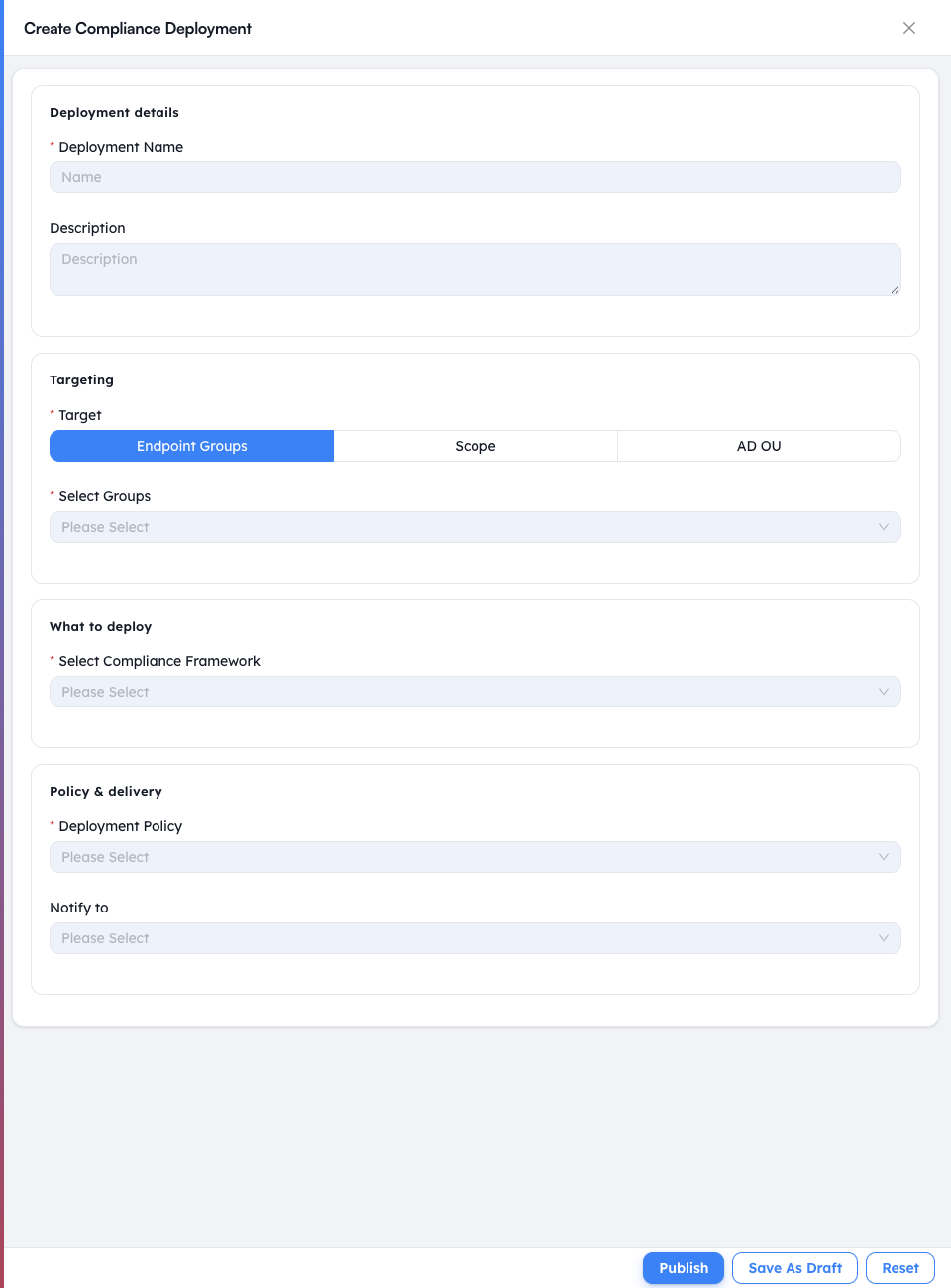
Click Create. The Create Compliance Deployment panel opens.
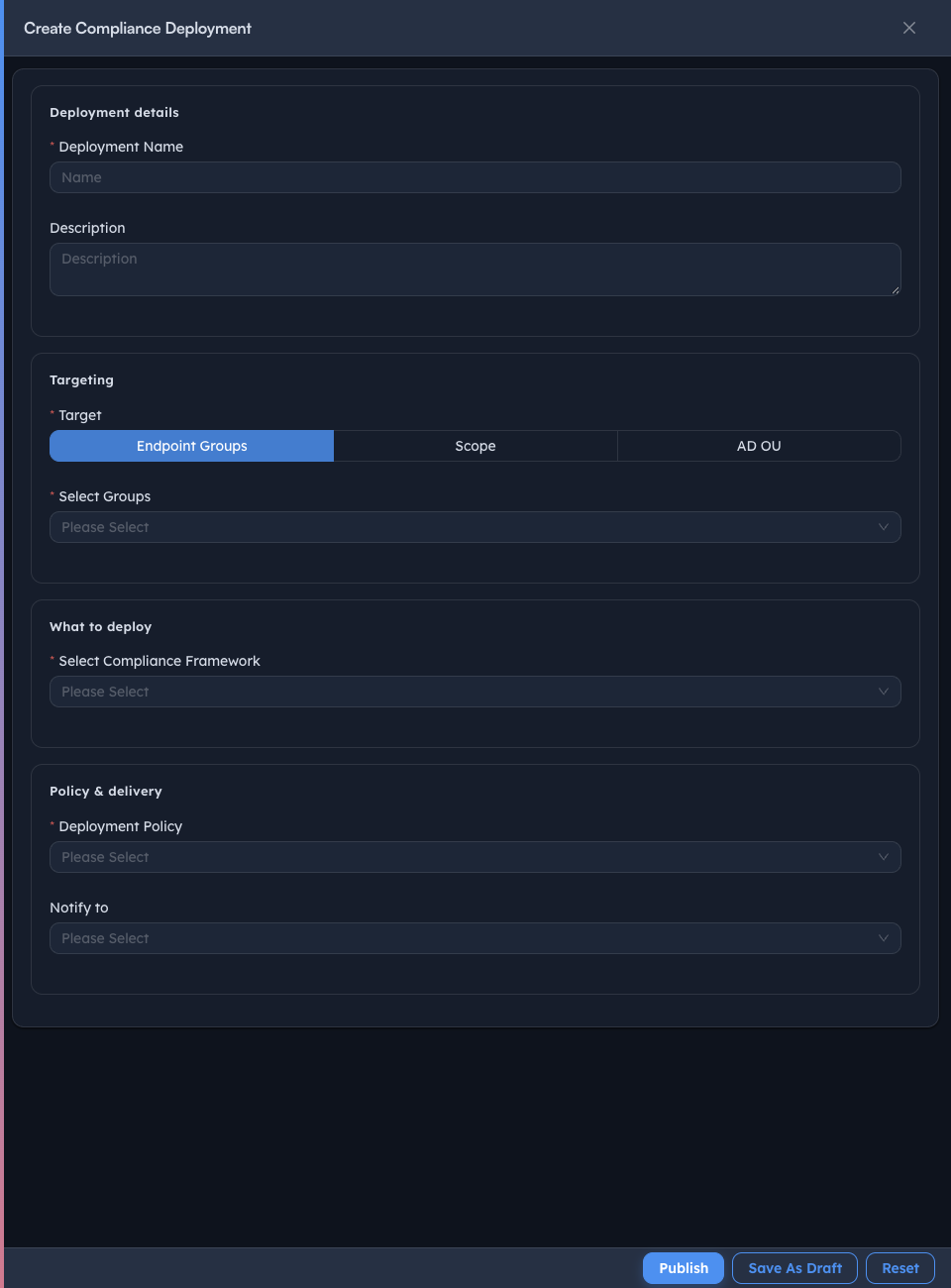
-
Fill in the form:
Field Required Notes Deployment Name Yes Deployment details section. A name for the deployment. Description No What it's for. Target Yes Targeting section. Which endpoints to run on: Endpoint Groups (default), Scope, or AD OU. See Choosing the target. Select Compliance Framework Yes What to deploy section. The framework to run. Each option shows the framework's OS icon and logo. Deployment Policy Yes Policy & delivery section. When and how it runs. Only policies whose Supported module is Compliances or All are listed. Once you pick one, a summary of the policy appears below it. Notify to No Email addresses to tell about the deployment. Pick a user's email or type any address. -
Click one of the buttons at the bottom:
- Publish starts the deployment.
- Save As Draft saves it without running it. You can edit and publish a draft later.
- Reset puts the form back the way it opened.
Choosing the target
The Target buttons decide which endpoints the deployment runs on:
- Endpoint Groups (the default): pick one or more groups in Select Groups (required). Groups are managed in Endpoint Groups.
- Scope: pick a Scope: All Endpoints, Specific Endpoints, Specific Departments, Specific Locations, Windows, Linux, or macOS. Then narrow it in the field beside it: Endpoints, Departments, Locations, or OS Version for a platform.
- AD OU: pick one or more Active Directory OUs in Select OUs (required). Every endpoint in a selected OU, or in any OU below it, is targeted.
AD OU is offered only to users who can see every department. A deployment already saved with an AD OU target always shows it.
A one-time deployment uses the endpoints that are in the OUs when you save it. A recurring deployment reads the OUs again on every run.
Choosing Scope → Windows, Linux, or macOS limits Select Compliance Framework to frameworks for that OS. Changing the Scope clears a framework you already picked, so set the target first.
How do I see the results?
Click a published deployment's View Result (eye) icon, or click its card. A panel opens, titled with the deployment's ID and name.
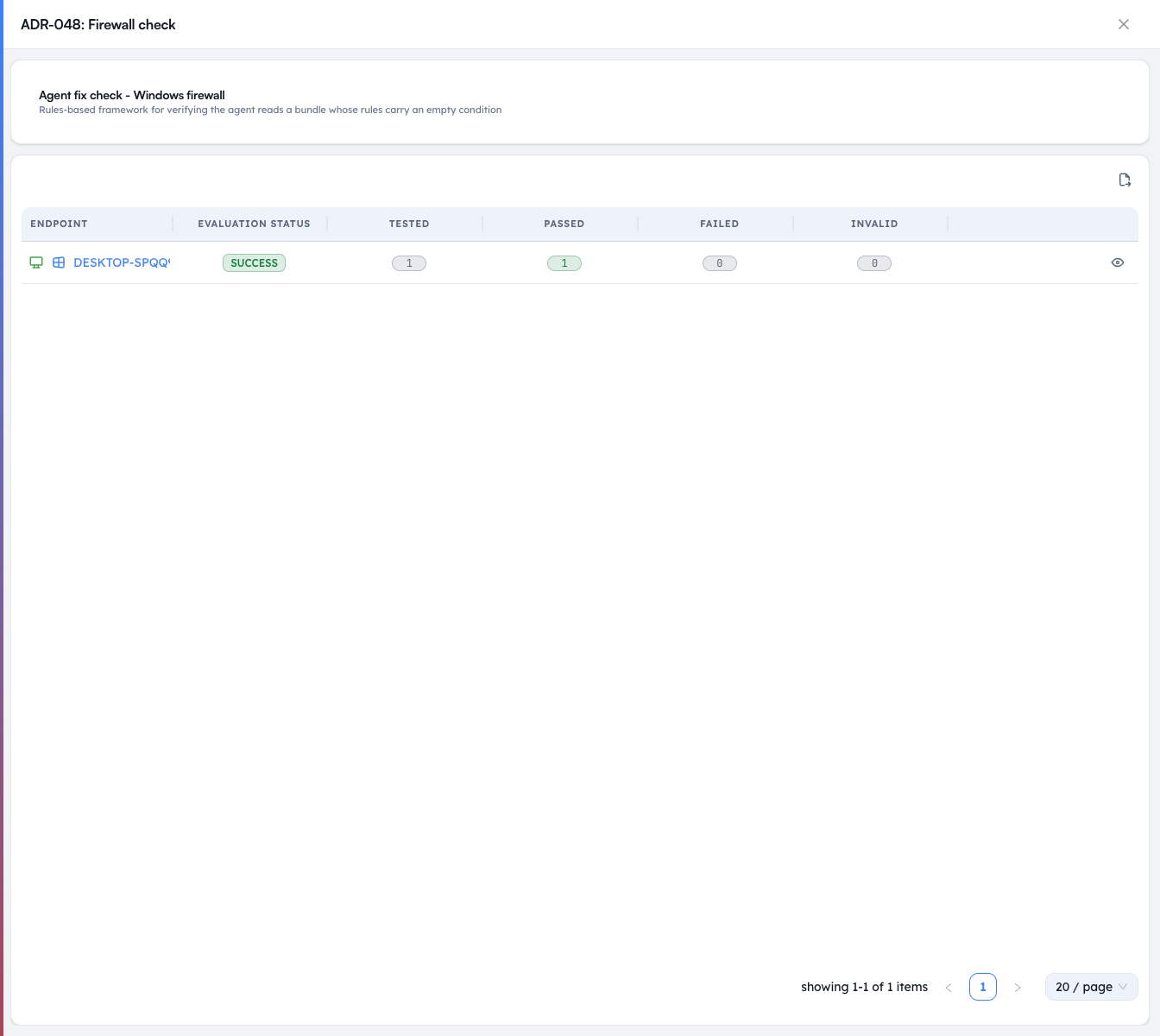
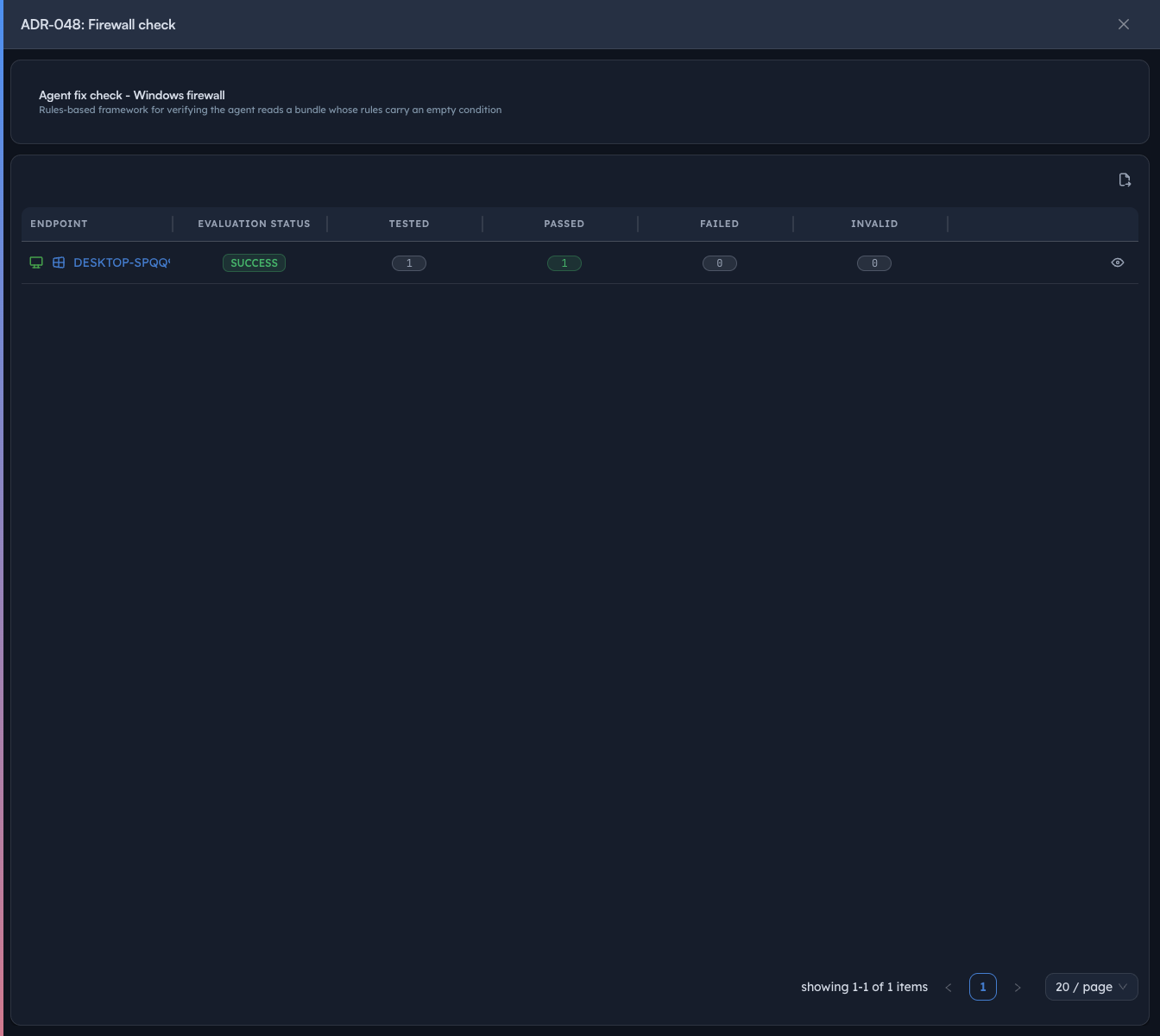
At the top is the framework's logo, name, and description. Below it, one row per endpoint:
| Column | What it shows |
|---|---|
| Endpoint | The endpoint. Click it to open the endpoint. |
| Evaluation Status | The status of the evaluation task on that endpoint. |
| Tested | How many rules were evaluated. |
| Passed | Rules that passed. |
| Failed | Rules that failed. |
| Invalid | Rules that couldn't be evaluated. |
The eye icon at the end of a row opens one of two panels:
- View Evaluated Rules (when the evaluation ran): the rule-by-rule results for that endpoint. It shows the pass rate, X/Y rules passed, and Passed / Failed / Invalid counts. You can search by rule name or output, filter by status (All Status, Passed, Failed, Invalid), and Export CSV. Expand a rule to compare its Expected output with its Actual output.
- View Result (when the evaluation task failed): the raw task output, so you can see why it failed.
The rule-by-rule panel is the same one you see on an endpoint's Compliance tab.
How do I edit or delete a deployment?
- Edit a draft: click edit (✏️), change the form, then Publish or Save As Draft.
- Delete: click delete (🗑️). Deleting needs the Delete Compliance permission.
Once a deployment is published, the edit action is gone. To change what runs, create a new deployment.
Choosing which columns to show
Click the Columns icon on the right of the toolbar to open the column picker. Tick the columns to show, untick to hide, drag to reorder, then click Apply. Created By, Description, and Created On are hidden until you turn them on.
Tips & troubleshooting
- The framework I want isn't listed. If you targeted a Scope platform, only frameworks for that OS appear. Check the framework's OS on the Compliance Framework tab.
- No deployment policy to pick. Only policies for Compliances or All are listed. Create one in Deployment Policies.
- Progress says No tasks. The deployment hasn't created any endpoint tasks yet. Check its stage and the deployment policy's schedule.
- A row shows View Result instead of View Evaluated Rules. The evaluation task failed on that endpoint. Open it to read the error.
Related
- Compliance Frameworks — what a deployment runs.
- Compliance Rules — the checks inside a framework.
- Endpoint › Compliance tab — one endpoint's compliance results.
- Deployment Policies — the schedule a deployment follows.
- Endpoint Groups — reusable sets of endpoints to target.